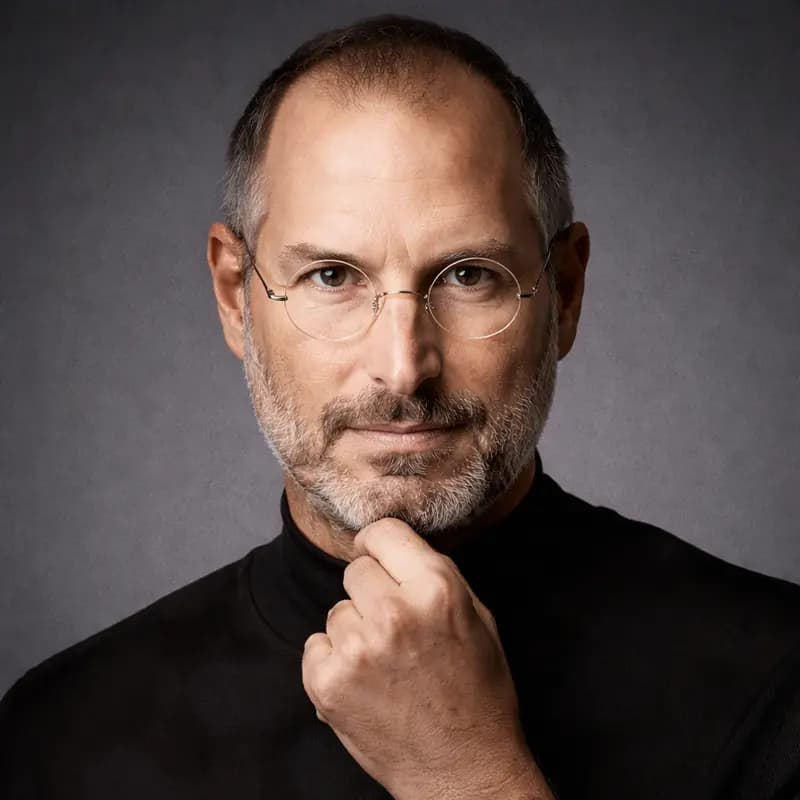
Steve Jobs


No notifications yet
You'll see activity here when people interact with your debates.
Debate Rules
AI scores every argument. Team with higher total wins. Stronger arguments bring more points. Pick your side, share your argument and help your team win.
Debate topic:
Who did more to shape the tech world as we know it?
Steve Jobs

Bill Gates
Steve Jobs Team
Bill Gates Team
Debate Rules
AI scores every argument. Team with higher total wins. Stronger arguments bring more points. Pick your side, share your argument and help your team win.
Steve Jobs
 Level1
 Top100%user
 Staked$0
Jobs permanently changed three industries in about fifteen years: music, phones, and personal computing. The iPod plus iTunes wasn't just a product — it ended the CD era and forced labels to restructure around digital distribution. The iPhone in 2007 didn't just create a new device category, it made every phone before it look like a toy. I keep coming back to the original Macworld keynote where he introduced it as 'an iPod, a phone, and an internet communicator' — three separate announcements before revealing it was one device. The simplicity of that framing was the entire Jobs philosophy in a single moment. The deeper thing he did was prove that design and experience are business strategy, not decoration. Before Apple's return under Jobs, the consensus was that specs and price moved products. He demolished that idea and rebuilt the premium hardware market around it. Every company selling something at a premium today is working inside a framework he established.
Level1Top100%userStaked$0The retail stores are an underrated part of the Jobs legacy and I don't see them get enough credit. Apple Stores launched in 2001 when virtually every retail analyst called it a guaranteed failure — why would people go to a store just to look at computers. By 2012 they had the highest revenue per square foot of any US retailer, beating luxury brands and jewelers. He understood that the store itself was part of the product, the physical place where people could feel what Apple made before they bought it. That control over everything from silicon design to the table you put your hands on in the shop is something no other tech company has managed to replicate.
Level1Top100%userStaked$0Something that usually gets skipped in this debate: Jobs was an exceptional talent attractor. The executives he pulled into Apple — Jony Ive, Tim Cook, the senior hardware engineering team — were unusually good. Building that organization while simultaneously owning product vision at the detail level he did was rare. Most founders can do one or the other.
Level1Top100%userStaked$0I think Jobs wins the cultural conversation even if Gates wins the enterprise argument, and cultural footprint tends to be stickier long-term. When people look back in 20 years at what defined early 21st century technology, they'll reach for the iPhone before Windows. That asymmetry matters for how legacies actually settle.
Level1Top100%userStaked$0Mac in 1984 was the first mass-market personal computer with a graphical interface ordinary people could actually use without reading a manual. Yes, Xerox PARC had the idea first. Jobs was the one who made it real for consumers. That's the pattern of his whole career: take something existing in a research lab and build it into something millions of people want.
Level1Top100%userStaked$0Jobs had taste and Gates didn't. Gates built useful things but they were never beautiful or pleasurable to use. In the long run people remember what they loved using, not just what they needed to use.
Level1Top100%userStaked$0The comeback arc has to count for something. Apple in 1997 was 90 days from bankruptcy. Jobs came back, killed most of the product line, focused on four products in a grid, and turned it into the most valuable company in the world. Gates never had to operate under that kind of pressure.
Level1Top100%userStaked$0Apple products feel better to use. That's a Jobs thing. Gates never cared about that.
Bill Gates
Level1Top100%userStaked$0Gates changed the economics of software in a way that still shapes how the entire industry operates. Before Microsoft the dominant model was hardware bundled with software — you bought IBM hardware and IBM software as a package deal. Gates saw that software could be a standalone business with near-zero marginal cost per additional copy, and he built the licensing model around that insight. Every SaaS company, every app store, every subscription you pay for today is downstream from what Gates proved worked. The scale numbers at peak are hard to argue with: Windows ran on around 90% of personal computers worldwide. Office was the default productivity environment for essentially every business on the planet. That kind of dependency, built through genuine utility rather than marketing, is a different category of achievement than what Jobs built. Jobs created desire. Gates created the infrastructure that professional work ran on.
Level1Top100%userStaked$0Windows enabled an enormous third-party ecosystem — millions of developers building businesses on top of Microsoft's platform. That spawned software companies, IT consultancies, enterprise training industries, and IT support businesses that simply couldn't have existed otherwise. Apple under Jobs was beautiful but always more closed. The Gates approach seeded a much larger economy even if the experience was uglier.
Level1Top100%userStaked$0The philanthropy shouldn't be dismissed as separate from the Gates legacy evaluation. The Bill and Melinda Gates Foundation has deployed over $60 billion. It has contributed meaningfully to reducing child mortality and helping push polio toward eradication. Jobs gave essentially nothing publicly during his lifetime. If we're scoring total impact on the world and not just impact on consumer product aesthetics, that comparison is not close.
Level1Top100%userStaked$0Gates also didn't rely on reality distortion. Jobs was famous for convincing people — including his own engineers — that things were done or possible when they weren't. Gates operated with more analytical rigor and still built something larger in terms of global daily reach. The mystique around Jobs sometimes obscures that.
Level1Top100%userStaked$0Microsoft Office created the default format for professional work. Word documents and Excel spreadsheets became the universal language of business across governments, corporations, schools, and nonprofits. That is infrastructure-level impact that billions of people still operate inside every day.
Level1Top100%userStaked$0Windows XP shipped in 2001 and was still running on hundreds of millions of devices in 2014 when Microsoft officially ended support. That's a specific kind of global reach Jobs never had.
Level1Top100%userStaked$0Most people who used a computer in the 90s and 2000s used Windows. That's the Gates impact.